Part 1: Cell & Molecular Biology
Chapter 7: Cell Division & Inheritance
This chapter's lab Divisive Bracelet
Before We Begin
Answer these in the WIKI square of your notebook before the lesson. Guess if you don’t know, and don’t look anything up.
- How does a scraped knee heal?
- Why can two siblings with the same parents look totally different?
- Can two brown-eyed parents have a blue-eyed kid?
Cell Division and Inheritance
The Basics
- Every cell comes from another cell. That’s cell theory, and this is how it actually happens
- Before a cell splits, it has to copy all of its DNA, so both new cells get a full set of instructions
- Mitosis makes two identical copies of a cell. It’s how you grow, heal a scraped knee, and replace the skin you shed every day
- Meiosis makes sex cells, sperm and eggs, with only half the chromosomes, so when two combine you’re back to a full set
- That’s why you got 23 chromosomes from each parent, not 46 from each. Otherwise every generation would double
- Meiosis also shuffles the deck, swapping chunks of DNA so every sex cell is one of a kind
- That shuffle is why siblings with the same parents can look totally different
- Mitosis keeps you the same. Meiosis makes the next generation different. And different is what evolution runs on
The Cell Cycle
- A cell’s life is a loop: grow, copy, split, repeat
- Most of that loop is interphase, the cell just living its life and getting ready. That’s about 90% of the time
- Interphase has three parts:
- G1: the cell grows, does its job, and builds up supplies
- S: the cell copies all of its DNA. S stands for synthesis, and it’s the whole reason the cell can split without losing anything
- G2: the cell double-checks everything, makes more supplies, and gets ready to divide
- Then comes mitosis, where the copied DNA gets split evenly, and cytokinesis, where the cell pinches in half
- A typical human cell runs the whole loop in about 24 hours
- Along the way are checkpoints, basically security guards asking “Is the DNA copied right? Is the cell big enough? Is it safe to split?” Fail a checkpoint and the cycle stops
- Some cells, like most nerve cells and heart muscle cells, step out of the loop and rarely divide again. That’s why brain and heart damage are so hard to heal
Chromosomes
- Every one of your cells holds about 6 feet of DNA, crammed into a nucleus way too small to see
- That’s like stuffing 24 miles of thread into a tennis ball
- The trick is packing: DNA wraps around spool proteins called histones, then coils, then coils again, like an old phone cord twisted up on itself
- The fully packed bundle is a chromosome
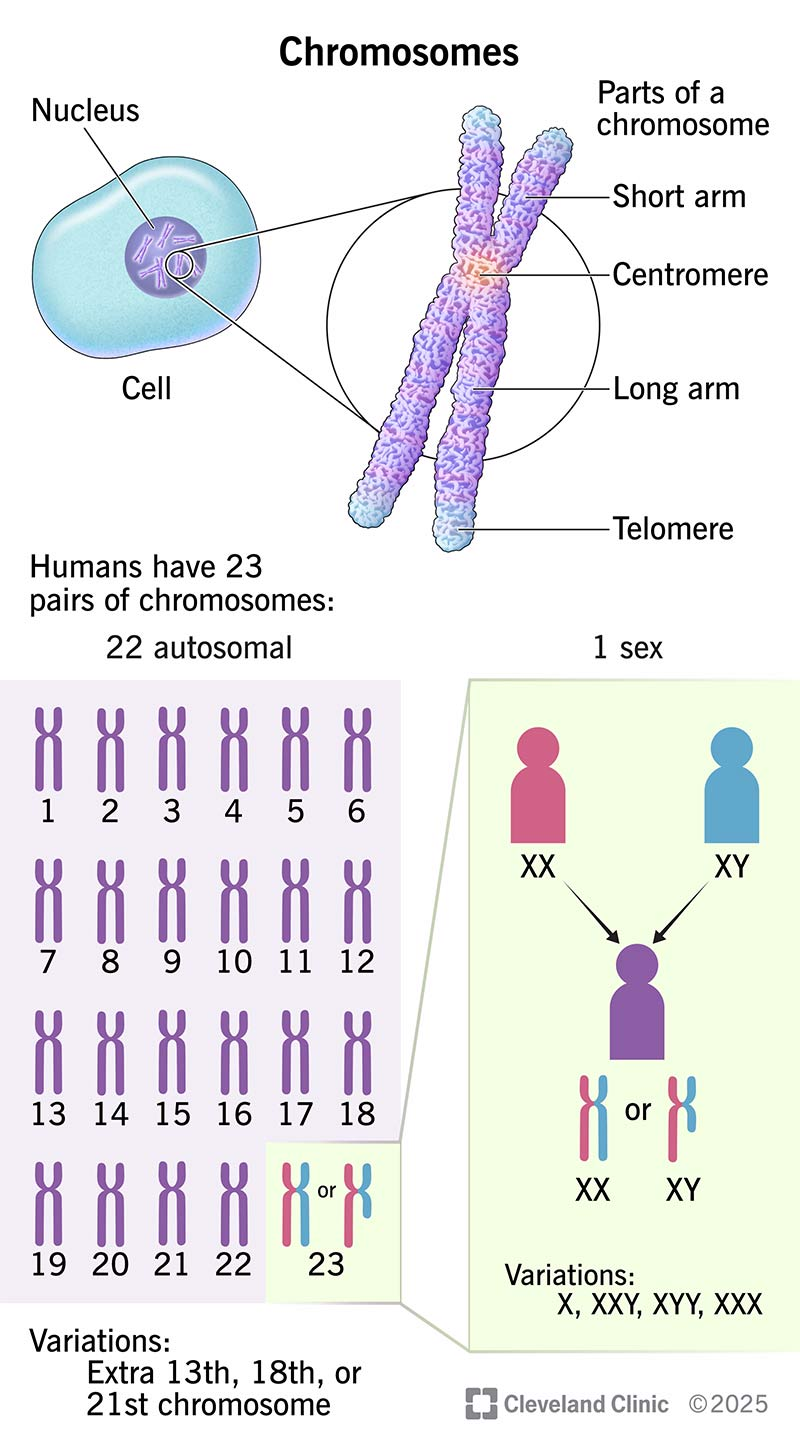
- Humans have 46 chromosomes, arranged in 23 pairs. One of each pair came from your mom, and one came from your dad
- The two chromosomes in a pair carry the same genes in the same order, but they can have different versions of those genes
- Pairs 1 through 22 are the same in everyone. Pair 23 are the sex chromosomes, usually XX or XY
- Most of the time, chromosomes are loose and spread out so genes can be read
- Right before a cell divides, each chromosome has been copied and bunches up tight. The two copies stay stuck together in the middle, making that classic X shape you’ve seen in pictures
- Each half of that X is called a sister chromatid, and mitosis is all about pulling them apart cleanly
Mitosis
- Mitosis is how one cell becomes two identical cells, each with the full 46 chromosomes
- It’s how you grew from one cell into about 37 trillion, and how you replace the millions of cells you lose every day
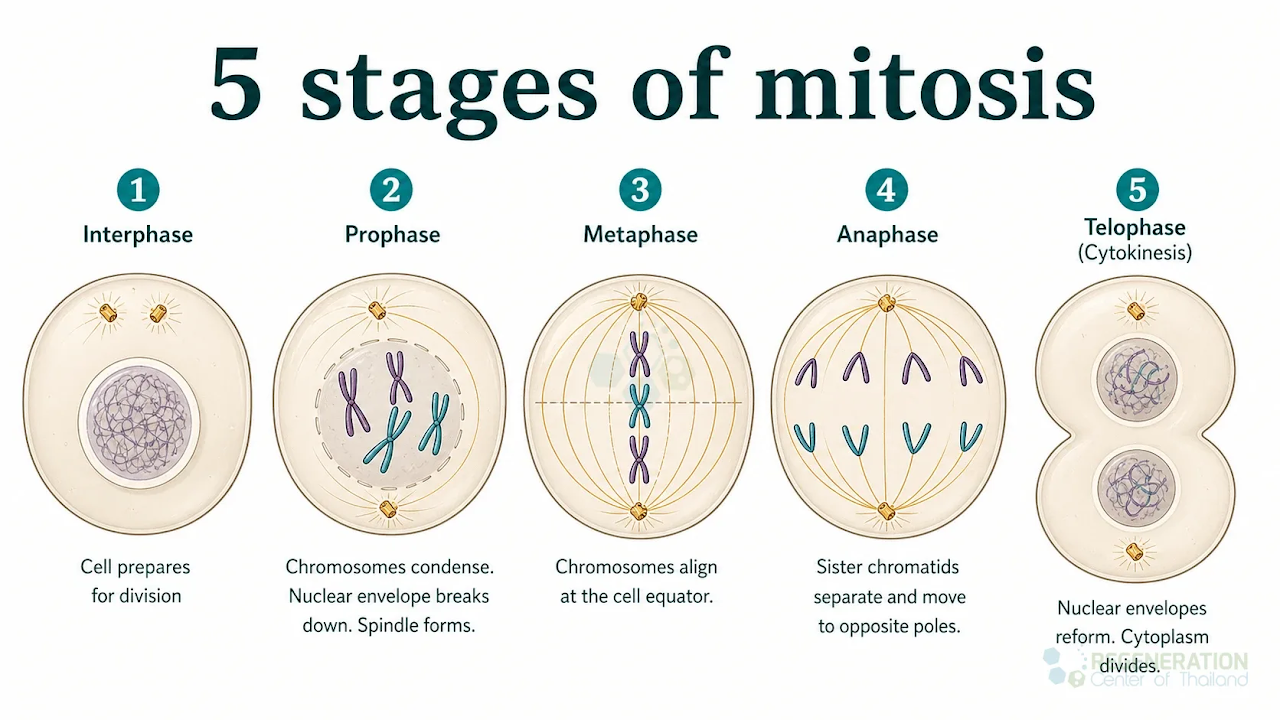
- It happens in four phases. Remember them as PMAT
- Prophase: the chromosomes bunch up into their X shapes, the nuclear membrane breaks down, and spindle fibers start stretching across the cell like ropes
- Metaphase: the spindle fibers grab each chromosome at its center and line them all up single file across the middle of the cell. M for middle
- Anaphase: the spindle fibers reel in, ripping each X apart. One sister chromatid gets dragged to each side. A for apart
- Telophase: a new nuclear membrane forms around each set of chromosomes, and they loosen back up. T for two nuclei
- Cytokinesis: the cell finally splits. Animal cells pinch in the middle like a balloon twisted in half. Plant cells can’t pinch through their cell wall, so they build a new wall straight down the center
- The result: two cells with identical DNA, each ready to start the cell cycle all over again
When Mitosis Goes Wrong
- Every time a cell divides, it has to copy 3 billion base pairs perfectly. Sometimes it doesn’t
- Most mistakes get caught at the checkpoints, and a damaged cell is supposed to shut itself down
- Cancer happens when mutations break the genes that control the cell cycle
- Some genes act like a gas pedal, telling cells to divide. A mutation can jam that pedal down
- Other genes act like brakes. The most famous one, p53, is nicknamed “the guardian of the genome.” Mutations can cut those brakes
- Usually it takes several mutations over time, which is one reason cancer is more common as people get older
- With the brakes cut and the gas stuck, the cell divides nonstop and ignores every checkpoint. The pile of extra cells is a tumor
- Benign tumors stay put. Malignant tumors invade nearby tissue and can spread through the blood to other parts of the body. That spread is called metastasis
- Things that damage DNA raise the risk: UV light, tobacco smoke, and some viruses like HPV. That’s why sunscreen and the HPV vaccine actually prevent cancer
- Chemotherapy and radiation work by attacking cells that divide fast. That’s also why they cause hair loss, since hair cells divide fast too
Meiosis
- Mitosis makes copies. Meiosis makes sex cells, sperm and eggs, and it plays by different rules
- Goal: cut the chromosome number in half, from 46 to 23, so when a sperm and egg combine, the baby ends up with exactly 46
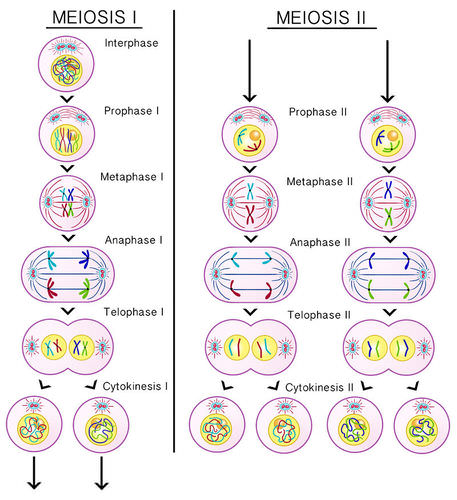
- To pull that off, meiosis divides twice
- Meiosis I: the chromosome pairs line up together, mom’s and dad’s side by side, and then get pulled apart. Each new cell gets one from each pair, not both
- Which one goes which way is totally random, like flipping a coin 23 times
- That alone gives about 8 million possible combinations of chromosomes in every sperm or egg
- Meiosis II: each of those cells splits again, just like mitosis, pulling the X-shaped chromosomes apart
- The result: four cells, each with 23 chromosomes, and no two alike
- Two parents together could make over 70 trillion different kids, and that’s before crossing over shuffles things even more
- When chromosomes don’t separate correctly, a sex cell can end up with an extra or missing chromosome. An extra copy of chromosome 21 is what causes Down syndrome
Crossing Over
- Independent assortment shuffles whole chromosomes. Crossing over shuffles the pieces inside them
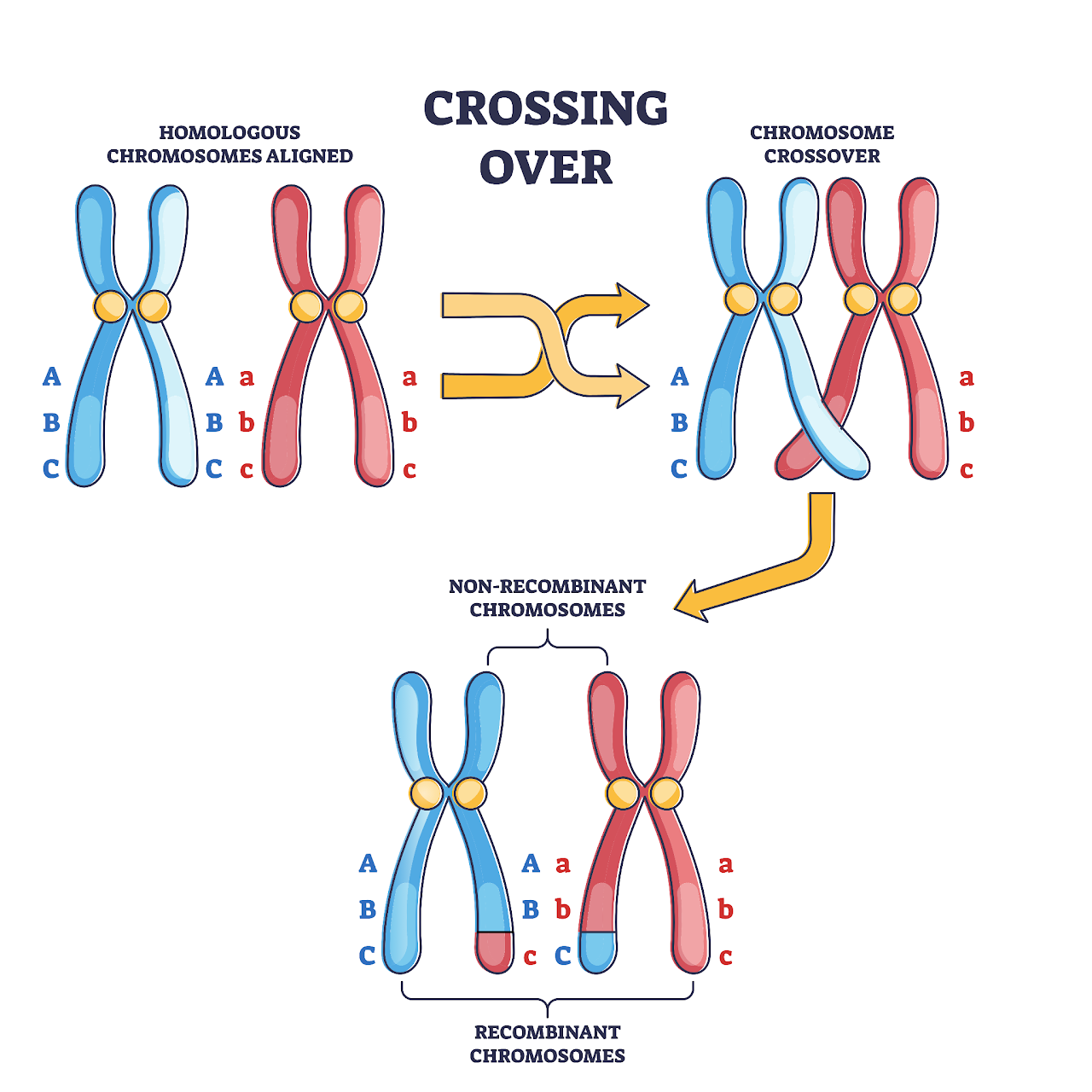
- It happens early in meiosis I, when each chromosome pair lines up side by side, mom’s and dad’s pressed together
- They get so tangled up that their arms physically cross, break at the same spot, and swap sections
- The result: chromosomes that are part mom’s side, part dad’s side. A brand-new mix that never existed before
- It happens a couple of times on every chromosome pair, about 50 swaps every time a sex cell is made
- That means the chromosome you pass to your kid isn’t your mom’s or your dad’s. It’s a patchwork of both, which means pieces of all four of your grandparents
- Genes that sit close together on a chromosome usually get swapped as a package. Genes far apart get split up more often
- Scientists used that to map where genes sit on chromosomes, starting with fruit flies over 100 years ago
- More mixing means more variety, and variety is the raw material evolution works with. No variety, no natural selection
Mendel and His Peas
- Meet Gregor Mendel, a monk in what’s now the Czech Republic in the 1850s
- Fun fact: he failed his teaching exam. Twice. Then he went and founded genetics
- He grew about 28,000 pea plants in the monastery garden over eight years
- Peas were perfect: they grow fast, make tons of offspring, and have obvious traits like purple or white flowers, tall or short stems, and round or wrinkled seeds
- He crossed purple-flowered plants with white-flowered plants. Every single baby had purple flowers. White just vanished
- Then he crossed those purple babies with each other. White came back, in about 1 out of every 4 plants
- That 3 to 1 ratio showed up over and over, trait after trait
- His conclusion: every trait is controlled by a pair of “factors,” one from each parent. Some factors hide others, but the hidden ones don’t disappear. They just wait
- Those factors are what we now call genes, and the versions are alleles. He figured this out with no microscope, no DNA, and no idea chromosomes existed
- He published in 1866, and basically nobody cared. He died thinking his work was forgotten
- In 1900, three different scientists rediscovered it at almost the same time, and Mendel became the father of genetics
Alleles: Dominant vs. Recessive
- A gene is a recipe. An allele is a version of that recipe, like grandma’s chili vs. the store-bought kind
- You get two alleles for every gene, one from each parent. They can match or be different
- We write them as letters: a capital letter for dominant (P), a lowercase letter for recessive (p)
- Dominant: shows up if you have even one copy. PP or Pp both give purple flowers
- Recessive: only shows up if you have two copies. Only pp gives white flowers
- Why? Remember protein synthesis. A recessive allele often makes a broken or weak protein. If you have one good copy, it makes enough working protein to cover for the broken one
- Two matching alleles (PP or pp) is homozygous. Two different alleles (Pp) is heterozygous
- Someone with one recessive allele that’s hidden is a carrier. They can pass it on without ever showing it. That’s how two parents without a trait can have a kid with it
- Big myth: dominant doesn’t mean more common or better. Having extra fingers is dominant, and it’s rare. Huntington’s disease is dominant, and it’s deadly
- Not every gene plays by these rules. Sometimes neither allele wins and you get a blend
Genotype vs. Phenotype
- Genotype is the letters, the alleles you actually have. PP, Pp, or pp
- Phenotype is what shows up, the trait you can see or measure. Purple or white
- Genotype is the recipe. Phenotype is the dish that comes out of the oven
- Phenotype isn’t just looks. Your blood type, whether you can digest milk, and how your body handles caffeine are all phenotypes too
- Here’s the catch: the same phenotype can hide different genotypes. A purple flower could be PP or Pp, and you can’t tell by looking
- That’s why scientists do test crosses, or now just sequence the DNA
- Genes aren’t the whole story. The environment changes phenotype too
- Siamese cats have a gene for dark fur that only works where the body is cold. That’s why their ears, paws, and tails are dark
- Hydrangeas with the same genes turn blue in acidic soil and pink in basic soil.
- You might have genes for being tall, but without enough protein and calories growing up, you won’t reach it. Your cookbook literally shapes your phenotype
Punnett Squares
- A Punnett square is a cheat sheet for predicting what kids two parents could have
- Named after Reginald Punnett, a British scientist who came up with it around 1905
- Draw a box split into four squares
- Write one parent’s two alleles across the top, and the other parent’s two alleles down the side
- Fill in each square with one letter from the top and one from the side, like a multiplication table
- Example: cross two purple Pp flowers. You get PP, Pp, Pp, and pp
- Genotype ratio: 1 PP : 2 Pp : 1 pp
- Phenotype ratio: 3 purple : 1 white. Mendel’s 3 to 1, explained in one little box
- Each square is a 25% chance, not a guarantee. It’s like flipping a coin. Two carrier parents could have four kids with the recessive trait, or none
- Every baby is a brand-new coin flip. Having one kid with a trait doesn’t change the odds for the next one
Mutations
- A mutation is any change in the DNA sequence. That’s it. Not superpowers, just a typo in the recipe
- They happen from copying mistakes, or from damage by UV light, radiation, and some chemicals
- You were born with around 60 brand-new mutations your parents didn’t have. Everyone is
- Substitution: one letter gets swapped for another. Like changing THE CAT ATE to THE BAT ATE
- Insertion or deletion: a letter gets added or dropped. Since the ribosome reads in threes, everything after it shifts. THE CAT ATE becomes THC ATA TE. Total garbage. That’s called a frameshift
- Many mutations do nothing. Remember that most amino acids have several codons? A swap can land on a different codon for the same amino acid
- Some are harmful. Sickle cell disease comes from one single letter swap in the hemoglobin gene, which bends red blood cells into sickles
- Some are helpful. That same sickle cell allele, in just one copy, protects against malaria. And most humans lose the ability to digest milk as adults, but a mutation lets some people keep it for life
- Mutations in body cells stay with you. Mutations in sex cells get passed to your kids
- Mutations are the only source of truly new alleles. Meiosis shuffles the deck, but mutations add new cards. That’s the fuel for evolution
In Summation
- Every cell comes from another cell, and the cell cycle is how it happens: grow, copy the DNA, check it, split
- DNA gets packed into chromosomes so it can be divided without tangling. You have 46, in 23 pairs, half from each parent
- Mitosis makes two identical cells for growth and repair. PMAT, then split
- When the cell cycle’s brakes and checkpoints fail, cells divide out of control. That’s cancer
- Meiosis makes sex cells with half the chromosomes, and shuffles them so no two are alike
- Crossing over mixes the pieces even more, so you pass on a patchwork of all four of your grandparents
- Mendel figured out the rules with peas: two alleles per gene, one from each parent, and some hide others
- Genotype is the letters, phenotype is what shows up, and environment has a say too
- Punnett squares predict the odds, but every kid is a new coin flip
- Mutations are typos in the code. Most do nothing, some cause disease, and a few are the new ideas evolution runs on
- And that’s Part 1. From goo to DNA to cells to energy to proteins to you. Every cell you have is the latest copy of a copy of a copy going back almost 4 billion years