Chapter 5: Energy
Before We Begin
Answer these in the WIKI square of your notebook before the lesson. Guess if you don’t know, and don’t look anything up.
- Where did the energy in your breakfast originally come from?
- A big tree weighs tons. Where do you think all that mass came from?
- Why do you breathe harder when you run?
Energy
The Basics
- Every living thing on Earth gets its energy from one of two places: - Breaking down food - cellular respiration, mitochondria, every animal - Capturing sunlight - photosynthesis, chloroplasts, every plant
- Okay so for real that’s one place- one just adds an extra step
- Plants use sunlight to build sugars
- Animals eat those sugars and burn them for energy
- The waste products of burning sugars are carbon dioxide and water
- Plants use carbon dioxide and water to build more sugars
- It is a perfect closed loop this is literally . . . . The Circle of Life
Get Down With The ATP
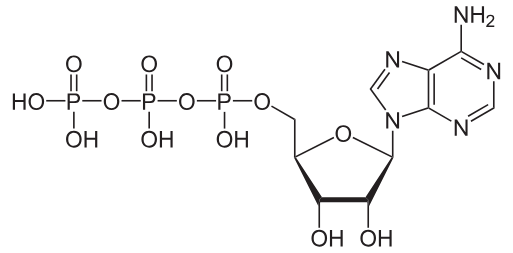
- Remember adenine? The A from DNA? She’s back, and she brought friends
- ATP stands for adenosine triphosphate
- It’s adenine, plus a ribose sugar, plus three phosphate groups stacked on the end
- Sound familiar? It’s basically a DNA nucleotide that got greedy and grabbed two extra phosphates
- Those phosphates all carry a negative charge, and they hate each other
- Cramming three of them together is like stuffing three angry cats in a backpack
- Snap off that last phosphate and all that tension releases as usable energy
- Now you’ve got ADP, adenosine diphosphate, a drained battery with only two phosphates
- Your mitochondria grab ADP, slap a phosphate back on, and recharge it into ATP
- Spend it, recharge it, spend it, recharge it, all day, every day, in every cell you have
- You only have about a quarter pound of ATP in your body at any moment
- But you recycle roughly your own body weight in ATP every single day
- Every heartbeat, every thought, every eye roll at your teacher, all paid for in ATP
Glucose
- If ATP is cash, glucose is the paycheck
- It’s a sugar, C₆H₁₂O₆, six carbons, twelve hydrogens, six oxygens, curled up in a ring
- Every bond in that ring is holding energy, and cells want it bad
- Plants make it from sunlight, air, and water, basically cooking with nothing
- Then everything else on Earth either eats the plant or eats something that ate the plant
- Your bread, your rice, your potatoes, your tortillas? All glucose chained together
- Plants store it as starch, you store it as glycogen in your liver and muscles
- Even wood and cotton are glucose, just chained in a way you can’t digest
- Remember deoxyribose from DNA? Your cells make it from glucose, so the sugar in your sandwich becomes the backbone of your DNA
- Your brain runs almost entirely on glucose and burns about 20% of your energy while doing it
- Break one glucose down with oxygen and you get around 30 ATP
- Break it down without oxygen and you get 2. That’s a terrible deal, and we’ll get to why anyone takes it
- Too little glucose in your blood and you’re shaky, dizzy, and cranky. Too much and it damages your body over time
- That balancing act is homeostasis, and it’s coming for you next quarter
Photosynthesis
- Plants are out here making food from air, water, and light like the lazy bums they are
- Remember the cyanobacterium that got swallowed and became the chloroplast? This is its whole job
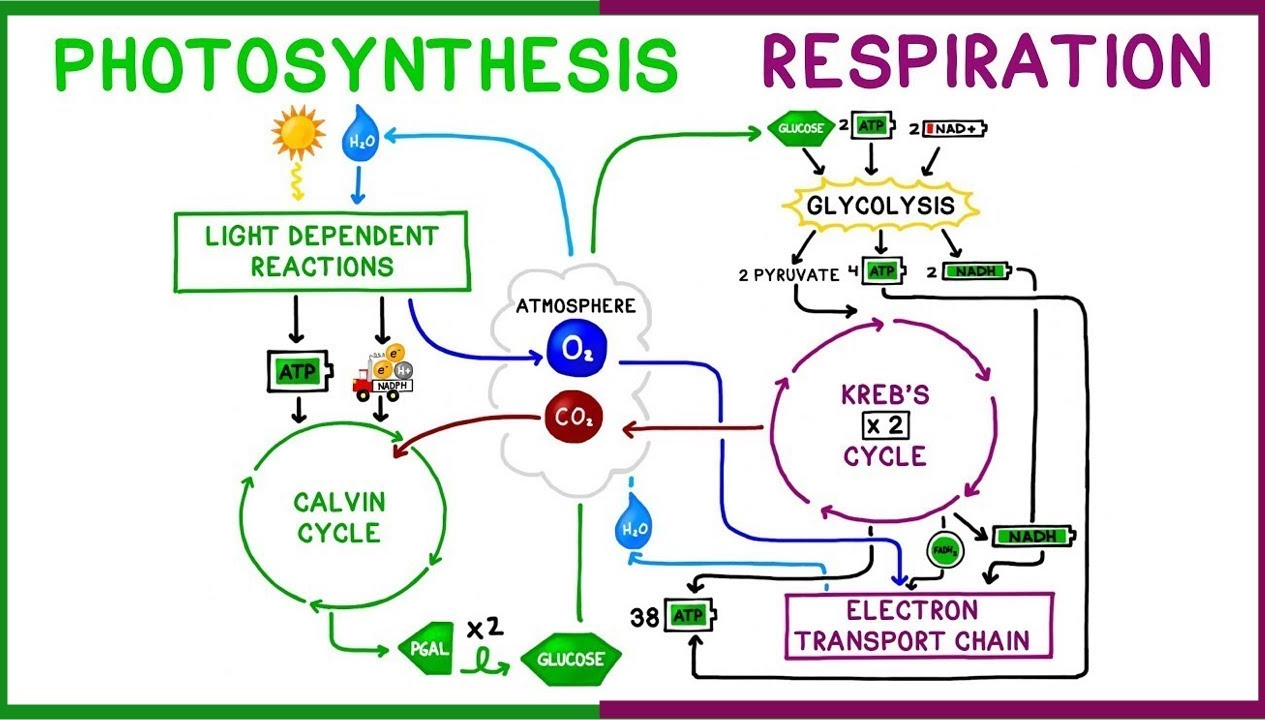
- The recipe: 6CO₂ + 6H₂O + sunlight → C₆H₁₂O₆ + 6O₂
- Translation: carbon dioxide plus water plus light makes glucose plus oxygen
- The magic ingredient is chlorophyll, a green pigment packed inside the chloroplast
- Chlorophyll soaks up red and blue light like a sponge
- It can’t use green light, so it bounces it back at you. That’s why plants are green. They’re literally rejecting it
- Step 1, the light reactions: chlorophyll catches sunlight and uses that energy to rip water molecules apart
- The leftover oxygen from those water molecules? That’s garbage to the plant. It dumps it out the leaves- farts, oxygen is plant farts.
- That fart is what you’re breathing right now. You’re welcome
- The energy gets stored in ATP, the same money molecule from before
- Step 2, building sugar (Or the Calvin Cycle if you’re fancy): the plant spends that ATP grabbing carbon dioxide out of the air and snapping the carbons together into glucose
- Here’s a bit of a brain break, a tree’s mass doesn’t come from the dirt. It comes from the air. A giant oak is mostly carbon dioxide that got built into wood
- About 2.4 billion years ago, early photosynthesizers pumped out so much oxygen they poisoned most of life on Earth
- The survivors learned to use that oxygen, and that’s the setup for cellular respiration
Cellular Respiration
- Photosynthesis built the glucose. Which means now we have snacks
- This happens in your mitochondria, the bacterial roommate that moved in two billion years ago and never left
- The recipe: C₆H₁₂O₆ + 6O₂ → 6CO₂ + 6H₂O + ATP
- Look familiar? It’s photosynthesis run backwards. Plants build it, you burn it
- It’s aerobic, meaning it needs oxygen. That’s the entire reason you breathe
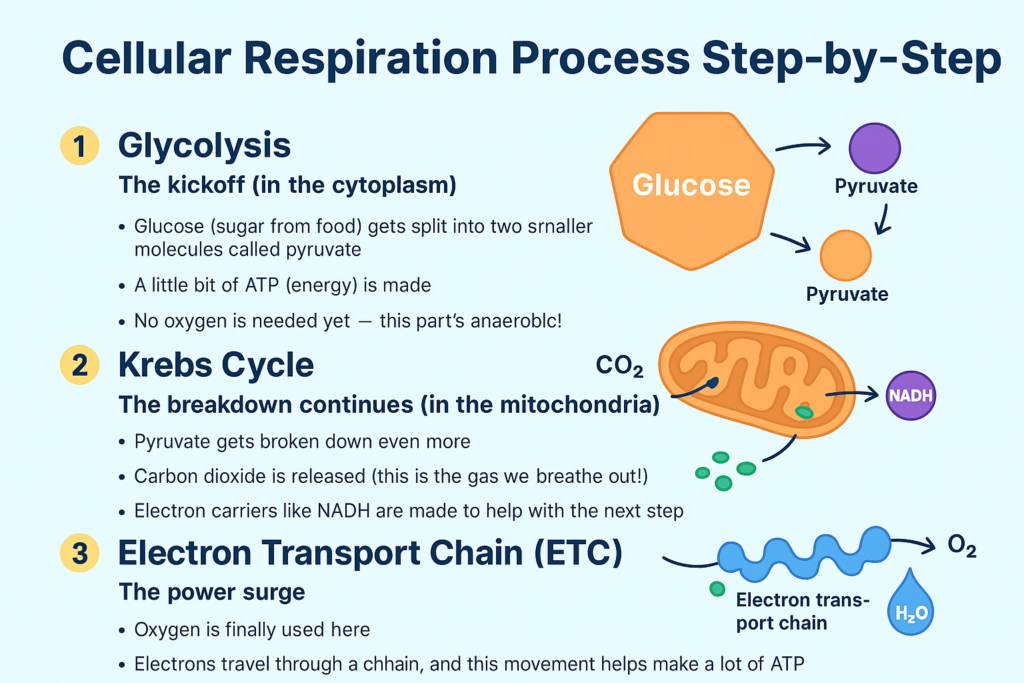
- Step 1, glycolysis: in the cytoplasm, glucose gets cracked in half. You get 2 ATP, no oxygen needed. Remember this, it matters later
- Step 2, the Krebs cycle: the halves go into the mitochondria and get picked apart carbon by carbon. Those carbons leave as carbon dioxide
- Step 3, the electron transport chain: this is where the real money is. High-energy electrons ripped from glucose get passed down a chain like a hot potato, powering a pump that cranks out ATP
- At the end of the chain, oxygen catches the used-up electrons and becomes water
- No oxygen to catch them? The whole chain jams, the ATP stops, and cells start dying within minutes. That’s what suffocation actually is
- Total payout: around 30 ATP per glucose, compared to 2 without oxygen
- The carbon dioxide you breathe out? Those are the carbon atoms from your food
- When people lose weight, most of that fat literally leaves their body as carbon dioxide. You exhale your fat
- Plants take that carbon dioxide and build glucose again. You and a tree are basically passing the same carbon back and forth
Aerobic vs. Anaerobic
- Aerobic means “with air.” Anaerobic means “without air.”
- Aerobic is the full deal: glycolysis, Krebs cycle, electron transport chain, about 30 ATP per glucose
- Anaerobic is what happens when oxygen doesn’t show up
- No oxygen means no one to catch electrons at the end of the chain, so the mitochondria shut down
- The cell is stuck with only glycolysis and its measly 2 ATP
- That’s like getting paid 2 dollars for a job that should pay 30
- Some organisms live like this full time. Plenty of bacteria find oxygen straight-up toxic, the same poison those early photosynthesizers dumped on the planet
- You go anaerobic too. Sprint hard enough and your muscles burn through oxygen faster than your blood can deliver it
- Your cells switch to plan B to keep the ATP coming, even if it’s a bad deal
- Plan B has a name, and it’s how we get bread, yogurt, pickles, and beer
- That’s fermentation
Fermentation
- Fermentation is plan B, and it’s kind of a scam
- Glycolysis cracks glucose and makes 2 ATP, but it uses up a helper molecule to do it
- Run out of that helper and glycolysis stops cold. No ATP at all
- With oxygen, the mitochondria recycle the helper. Without oxygen, nobody does
- Fermentation’s whole job is to recycle that helper so glycolysis can keep going
- It makes zero extra ATP. It just keeps the 2 ATP coming
- To pull it off, the cell dumps the leftover glucose halves into a waste product
- Lactic acid fermentation: the waste is lactic acid. Your muscles do this during a hard sprint, and so do the bacteria that make yogurt, sauerkraut, pickles, and sourdough
- Fun fact: lactic acid gets blamed for next-day soreness, but that’s actually tiny tears in your muscle fibers. Your body clears lactic acid within about an hour
- Alcoholic fermentation: yeast does it, and the waste is alcohol and carbon dioxide
- The carbon dioxide bubbles are what make bread rise. The alcohol bakes off in the oven
- Leave the alcohol in and you get beer and wine. Same yeast, same process, very different Friday night
- Humans have been using microbes’ garbage to feed ourselves for over 10,000 years, long before anyone knew microbes existed
- Cheese, chocolate, coffee, soy sauce, kimchi, salami: all fermented.
All the other stuff
But Wait, What About Other Fuels?
-
Glucose gets all the attention, but your cells aren’t picky eaters
-
Pretty much any food molecule can get chopped up and fed into cellular respiration
-
They just enter the line at different spots Carbohydrates
-
Starches get broken down into glucose. Other sugars like fructose (fruit) and lactose (milk) get converted into glucose or something close to it
-
Fast, easy energy. About 4 calories per gram
-
This is your body’s first choice, especially your brain Fats
-
Fats get split into glycerol and fatty acids
-
The fatty acids get chopped into two-carbon pieces and fed straight into the Krebs cycle
-
About 9 calories per gram, more than double carbs
-
That’s why your body stores extra energy as fat. It’s the most energy you can pack into the smallest space
-
Slow to access, though. Great for a long hike, bad for a sprint Proteins
-
Proteins get broken down into amino acids
-
Before they can be burned, the nitrogen has to be ripped off
-
That nitrogen turns into ammonia, which is toxic, so your liver converts it to urea and you pee it out
-
About 4 calories per gram, same as carbs
-
Your body really doesn’t want to burn protein. It’s building material, not fuel. It only goes for it when you’re starving, and then it starts eating your muscles Ketones
-
When carbs run out, your liver turns fat into ketones
-
Ketones are the backup fuel for your brain, since your brain can’t burn fatty acids directly
-
This is the whole idea behind keto diets and how humans survived long stretches without food (also no bueno long term for your body) The bottom line
-
Carbs are the quick cash, fats are the savings account, and protein is selling your furniture to pay rent
In Summation
- Life runs on energy, and cells can only spend it one way: ATP
- The sun is where almost all of it starts
- Plants catch sunlight with chlorophyll and use it to build glucose out of air and water
- Everything else eats plants, or eats something that ate plants
- Your mitochondria break that glucose back down with oxygen and cash it in for about 30 ATP
- No oxygen? Fermentation keeps you limping along on 2 ATP, and gives us bread, yogurt, and pickles as a bonus
- Carbs are quick cash, fats are savings, protein is selling the furniture
- Photosynthesis builds it, respiration burns it. Carbon dioxide and oxygen go back and forth between you and every plant on Earth
- That same carbon has been cycling since the first cyanobacterium figured out how to eat light