Part 1: Cell & Molecular Biology
Chapter 6: Protein Synthesis
This chapter's lab Message for a Future Class
Before We Begin
Answer these in the WIKI square of your notebook before the lesson. Guess if you don’t know, and don’t look anything up.
- What does your body use protein for?
- If DNA stays locked in the nucleus, how do you think its instructions get out?
- Your eye cells and stomach cells have the same DNA. Why do you think they do different jobs?
Protein Synthesis
The Basics
- Protein synthesis is how your cells turn DNA’s instructions into actual working proteins
- It’s basically Chapter 3’s “a section gets read, the protein gets built,” but now we’re opening the hood
- Problem: DNA is locked in the nucleus, and the ribosomes that build proteins are outside it
- DNA is way too valuable to leave the vault, so the cell makes a copy instead
- Step 1, transcription: a gene gets copied into mRNA inside the nucleus
- Step 2, translation: the mRNA heads out to a ribosome, which reads it three letters at a time and builds a chain of amino acids
- That chain folds up into a protein and goes to work
- Your cells do this millions of times a second, and it’s happening right now while you read this
Let’s Build Some Proteins
- Your cells don’t build every protein all the time. That would be like cooking every recipe in the cookbook at once
- Every cell has all 20,000 genes, but most of them stay switched off
- A cell starts building a protein when it gets a signal that it needs one, like a hormone, a change in temperature, or running low on something
- Eat a big bowl of pasta, your blood sugar rises, and cells in your pancreas get the message: time to make insulin
- That signal activates proteins called transcription factors, basically the cell’s foremen
- Transcription factors find the gene they’re after and latch onto its promoter, the “start here” sign right before the gene
- That’s the flag that calls in RNA polymerase to start copying
- Which genes get switched on is also what makes a muscle cell a muscle cell and a nerve cell a nerve cell. Same DNA, different recipes in use
Part 1: Transcription
- Transcription is the cell making a copy of one gene so the instructions can leave the nucleus
- Think of it like snapping a photo of one recipe instead of hauling the whole cookbook to the kitchen
- The copy is made of RNA, DNA’s single-stranded cousin
- RNA uses the same base-pairing rules with one swap: uracil (U) takes thymine’s place, so A pairs with U
- Only one side of the DNA gets read. The other side just hangs out until the copy is done
- The worker doing all this is an enzyme called RNA polymerase
- The finished copy is mRNA, messenger RNA, and its whole job is to carry the message out to the ribosomes
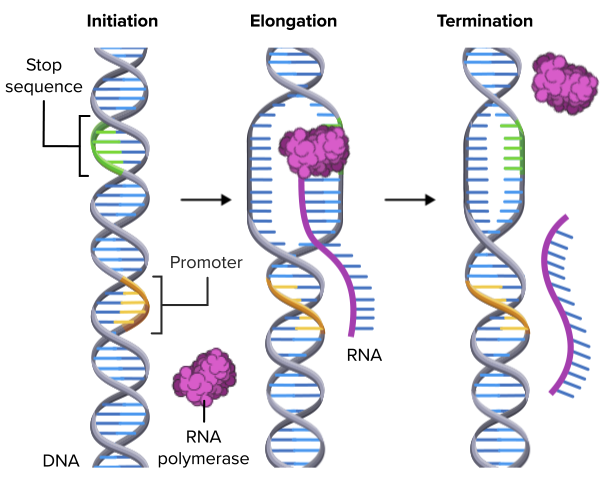
- Transcription happens in three parts: initiation, elongation, and termination
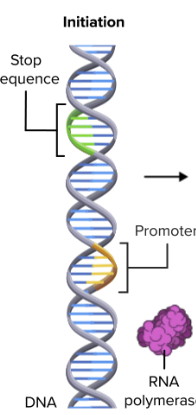
Transcription: Initiation
- The transcription factors are already parked on the promoter, waving RNA polymerase in
- RNA polymerase shows up and locks onto the promoter
- The promoter also tells it which direction to go and which side of the DNA to read, so it doesn’t copy the gene backwards
- RNA polymerase pries the two DNA strands apart, but only a small section, about a dozen base pairs
- That little open pocket is called the transcription bubble
- The bases on the template side are now exposed and ready to be read
- RNA polymerase grabs the first matching RNA nucleotide, and the copy officially begins
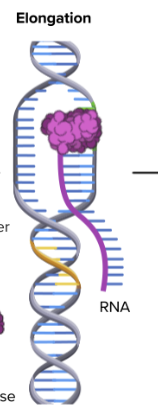
Transcription: Elongation
- RNA polymerase starts cruising down the gene, reading the DNA one base at a time
- For every DNA base, it grabs the matching RNA base: A gets U, T gets A, G gets C, C gets G
- It snaps each new base onto the growing mRNA chain
- Those incoming RNA nucleotides arrive with three phosphates, just like ATP. Snapping off two of them powers the link. Same energy trick from last chapter
- The transcription bubble moves along with it, unzipping DNA in front and zipping it back up behind
- The growing mRNA peels off the DNA like a receipt printing out of a register
- It moves at around 50 bases a second, so an average gene takes a few minutes
Transcription: Termination
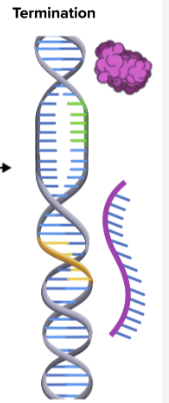
- RNA polymerase keeps copying until it hits a stop signal at the end of the gene
- The stop signal tells it the recipe is done, so it lets go of the DNA and floats off to find another gene
- The last of the DNA zips back up, good as new, like nothing ever happened
- The fresh mRNA gets cut loose, but it isn’t ready to leave yet
- The cell slaps a protective cap on the front and a long tail of A’s on the back, like bubble wrap for the trip
- It also snips out sections that aren’t part of the recipe and splices the useful parts back together
- The finished mRNA squeezes out through a pore in the nuclear membrane and heads for a ribosome
Translation
- Transcription made the copy. Translation is where the cell actually reads it and builds something
- It’s called translation because the cell is switching languages, from the language of bases (A, U, G, C) to the language of amino acids
- It happens at the ribosomes, out in the cytoplasm or stuck to the rough ER
- The ribosome reads the mRNA three bases at a time. Each three-letter chunk is a codon
- There are 64 possible codons but only 20 amino acids, so most amino acids have a few different codons that spell them. Built-in typo protection
- tRNA is the delivery driver. Each one carries a specific amino acid and has a matching three-letter code (an anticodon) that fits only the right codon
- The ribosome links the amino acids into a chain, and the chain folds into a working protein
- Translation happens in three parts: initiation, elongation, and termination
Translation: Initiation
- The mRNA pops out of the nucleus, and the small half of a ribosome grabs onto its cap
- Ribosomes come in two pieces, a small half and a large half, that only snap together when there’s work to do
- The small half slides down the mRNA, scanning for the start codon: AUG
- A special tRNA carrying the amino acid methionine latches onto AUG
- That means every protein starts with methionine. The cell often trims it off later, but it’s always the opener
- The large half of the ribosome clamps down on top, and the ribosome is fully built
- The ribosome has three parking spots for tRNAs, and the methionine tRNA is already sitting in the middle one, waiting for the next delivery
Translation: Elongation
- The ribosome reads the next codon, and the tRNA with the matching anticodon slides into the open parking spot
- Now two amino acids sit side by side, and the ribosome links them with a peptide bond
- Plot twist: the part of the ribosome that forms that bond isn’t protein, it’s RNA. Remember RNA was probably the first molecule of life? It’s still running the most important job in the cell
- The ribosome scoots forward exactly three bases to the next codon
- The empty tRNA gets kicked out the exit, goes to grab another amino acid, and comes back for another run
- Repeat, repeat, repeat. The growing chain threads out of a tunnel in the ribosome like a noodle
- Your ribosomes add about 5 amino acids a second, and several ribosomes can work the same mRNA at once, like a line of cars on the same road
Translation: Termination
- The ribosome keeps chugging until it hits a stop codon: UAA, UAG, or UGA
- No tRNA matches a stop codon, so nothing gets delivered
- Instead, a protein called a release factor slides into the empty spot and cuts the finished chain loose
- The ribosome splits back into its two halves, ready for the next mRNA
- The mRNA can get read a few more times, but it’s built to break down eventually, so the cell doesn’t keep making a protein it no longer needs
- The amino acid chain folds itself into a precise 3D shape, and that shape is everything. A protein that folds wrong doesn’t work, and misfolded proteins are behind diseases like Alzheimer’s
- If the protein is headed out of the cell, it takes the route from last chapter: through the ER, packaged by the Golgi, and shipped out
Protein Synthesis Conclusion
In Summation
- Every protein in your body starts as a signal: the cell needs something, so it flips on a gene
- Transcription copies that gene into mRNA, so the precious DNA never has to leave the nucleus
- The mRNA gets capped, tailed, trimmed, and shipped out to a ribosome
- Translation reads the mRNA three letters at a time and turns codons into a chain of amino acids
- tRNA delivers the parts, the ribosome snaps them together, and a stop codon ends the job
- The chain folds into a shape, and that shape decides what the protein does
- Those amino acids come from your food, and nine of them your body can’t make, so what you eat literally becomes the proteins you’re made of
- Change one letter in a gene and you can change the protein. Sometimes that’s nothing, sometimes it’s a disease, and sometimes it’s the start of evolution