Lab: Wood Medallion
Wood Medallion
You’re going to wear stored sunlight. A tree’s wood is built mostly from carbon dioxide pulled out of the air and joined with water, using energy from the sun. That’s photosynthesis. When the tree, or you, breaks those sugars back down with oxygen, the energy comes back out. That’s cellular respiration. One side of your medallion shows each.
You may get to wear your medallion during quizzes and tests, so make it something that will actually help you.
You need: a wood slice (about 3 to 4 inches across, with a hole drilled near the edge) · cord · sandpaper · fine Sharpies or paint pens · pencil · scrap paper
Step 1: Draft It on Paper First
Trace your wood slice on paper twice, one circle for each side. This is your practice run. Once it’s on the wood, it’s permanent.
Step 2: Side 1, Photosynthesis
Draw and label:
- The sun, with light energy coming in.
- A leaf, with a chloroplast zoomed in.
- What goes in: carbon dioxide (from the air) and water (from the roots).
- What comes out: glucose (stored in the plant) and oxygen (released to the air).
- The equation: 6CO₂ + 6H₂O + light energy → C₆H₁₂O₆ + 6O₂
Step 3: Side 2, Cellular Respiration
Draw and label:
- A mitochondrion.
- What goes in: glucose and oxygen.
- What comes out: carbon dioxide, water, and ATP.
- Your ATP numbers: about 30 ATP per glucose with oxygen, and only 2 without it (fermentation).
- The equation: C₆H₁₂O₆ + 6O₂ → 6CO₂ + 6H₂O + ATP
Add an arrow or symbol that shows the two sides are a loop: the outputs of one side are the inputs of the other.
Step 4: Get It Checked
Have your paper draft checked before you touch the wood.
Step 5: Sand and Draw
- Lightly sand both faces of your wood slice so the markers go on smooth.
- Pencil your design on lightly, then go over it with Sharpies or paint pens.
- Let it dry, then thread your cord through the hole.
Lab Sheet
- The Key: what each drawing on your medallion stands for.
- Where It’s Wrong: at least two ways the real processes are different from your medallion. Think about how many steps each process really has.
- What If?: cut off the oxygen. What happens to your ATP number, and what does the cell do instead?
Earlier lab: Digestion Lab
Digestion Lab
The question: Can yeast digest every kind of food? Yeast are living cells. When they digest sugar for energy, they release carbon dioxide gas. More gas means more digestion. Your balloons will tell you who’s eating and who’s starving.
Materials
- 6 empty plastic water bottles (16 to 20 oz), labeled 1 to 6
- 6 balloons (latex-free), stretched out a few times before use
- Dry yeast, 1 teaspoon per bottle
- Warm water, about 1 cup per bottle (warm to the touch, like bath water, not hot)
- Funnel
- Measuring spoons and cup
- String and a ruler, or a flexible measuring tape
- Timer
- Test foods, 1 tablespoon each:
- Nothing (control)
- Table sugar
- Honey
- Corn Starch
- Flour
- Artificial sweetener
Safety
- Goggles on during setup
- Water should be warm, not hot. Too hot will burn you and kill the yeast
- Latex-free balloons only
- No tasting anything, even if it’s just sugar
- If a balloon pops, stay put and let the teacher know
- Pour everything down the sink with running water at the end, rinse and recycle the bottles, wash your hands
Procedure
- Label bottles 1 to 6
- Use the funnel to add 1 teaspoon of yeast to each bottle
- Add 1 tablespoon of the test food to its matching bottle. Bottle 1 gets nothing
- Add 1 cup of warm water to each bottle
- Immediately stretch a balloon over each bottle opening
- Gently swirl each bottle to mix
- Measure the circumference of each balloon at its widest point. Wrap the string around the balloon, then measure the string with the ruler. Record it as time 0
- Measure again every 5 minutes for 30 minutes
Data Table
*All measurements in centimeters
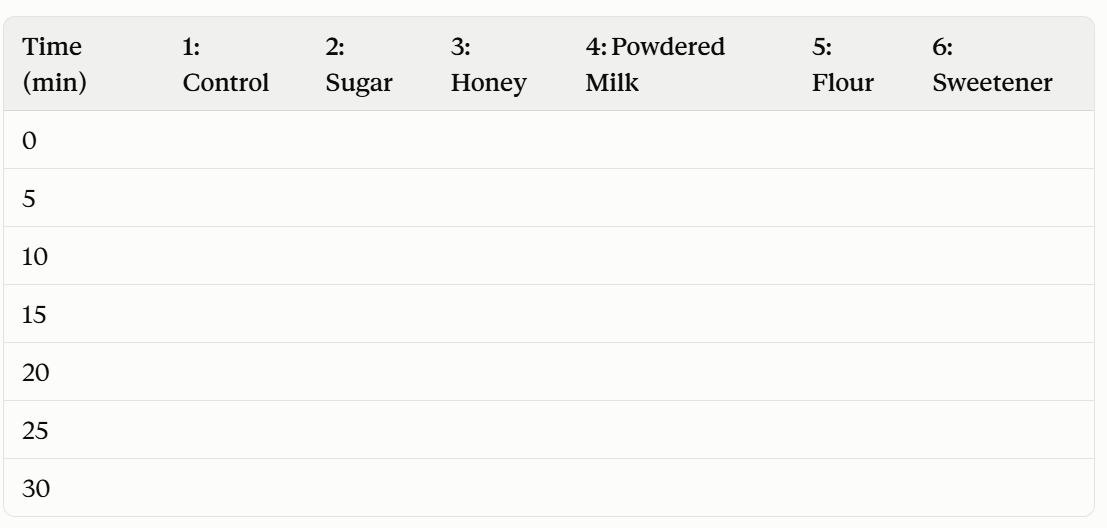
Graph
Make a line graph of your data:
- X-axis: Time (minutes)
- Y-axis: Balloon circumference (cm)
- One line for each bottle, in a different color, with a key
- Give it a title
Conclusion
Answer in complete sentences:
- Which food did the yeast digest best? Which did it digest worst? Use your data.
- Why was bottle 1 important?
- What gas filled the balloons, and what process made it?
- Why do you think the yeast couldn’t use some of the foods?
- What does this lab have to do with making bread?
Lab Sheet
Complete and add to your science notebook at the end of the Energy Section
Page 1
Your lab, visually. Sketches of the setup, drawings of the balloons at the end, everything labeled. Someone should be able to understand your lab just by looking at this page.
Page 2
Step-by-step procedure in your own words, data table, observations, graph, and conclusion.