Lab: Message for a Future Class
Message for a Future Class
Your group is going to write a message for next year’s class and hide it in genetic code. Your message becomes a protein, the protein becomes mRNA, and the mRNA becomes a strand of beads on our class curtain. Next year’s class will decode your strand before they write their own.
You need: your codon chart · beads in four colors plus spacer beads · string · a tag · your lab sheet
Color Key
This key stays posted by the curtain every year, so everyone can decode it.
Spacer bead (clear) between every codon.
Step 1: Write Your Message
Write a short message for next year’s class, 15 letters or fewer. Six letters have no amino acid: B, J, O, U, X, and Z. If your message uses one, find a different word or a creative spelling. That’s part of the puzzle.
Step 2: Letters to Amino Acids
Each amino acid has a one-letter code. Write the amino acid for each letter of your message (for example, W = tryptophan, H = histidine, Y = tyrosine).
Step 3: Amino Acids to Codons
Use the codon chart to pick an mRNA codon for each amino acid. Most amino acids have more than one codon, so choose any one that works.
Step 4: Add Start and Stop
- Begin your strand with the start codon, AUG. (AUG also codes for M, so decoders know to skip that first one.)
- End your strand with a stop codon: UAA, UAG, or UGA.
Step 5: Work Backward to the Gene
On your lab sheet, write the DNA template strand that would make your mRNA. Remember the pairs: mRNA A pairs with DNA T, U with A, G with C, and C with G.
Step 6: Check It
Trade with another group. They decode your mRNA back into your message using only the codon chart. If they get your message, you’re ready to string.
Step 7: String Your Strand
String your beads in order using the color key, with a spacer bead between each codon. Tie a tag on the end with your group name and the year, then hang it on the curtain.
Step 8: Decode Last Year’s Strands
Pick a strand left by last year’s class and decode it. Write their message and your work on your lab sheet.
Lab Sheet
- The Key: bead colors to bases, and your codons to amino acids to letters.
- Where It’s Wrong: at least two ways real protein synthesis is different from your strand. Think about where it happens, what reads the mRNA, and what real amino acids are.
- What If?: change one bead in your strand. What happens to your message, and what would that mean for a real protein?
Earlier lab: Code On Lab
Code On Lab
Every protein in your body is written in a code. Today you learn to read it, write it, and leave a message in it for the students who come after you.
Lab Sheet: Front Page
Draw the codon wheel on the front of your lab sheet. Make it big, make it clear, and label every amino acid. You’ll use it for the rest of this lab, and it may come in handy on test day.
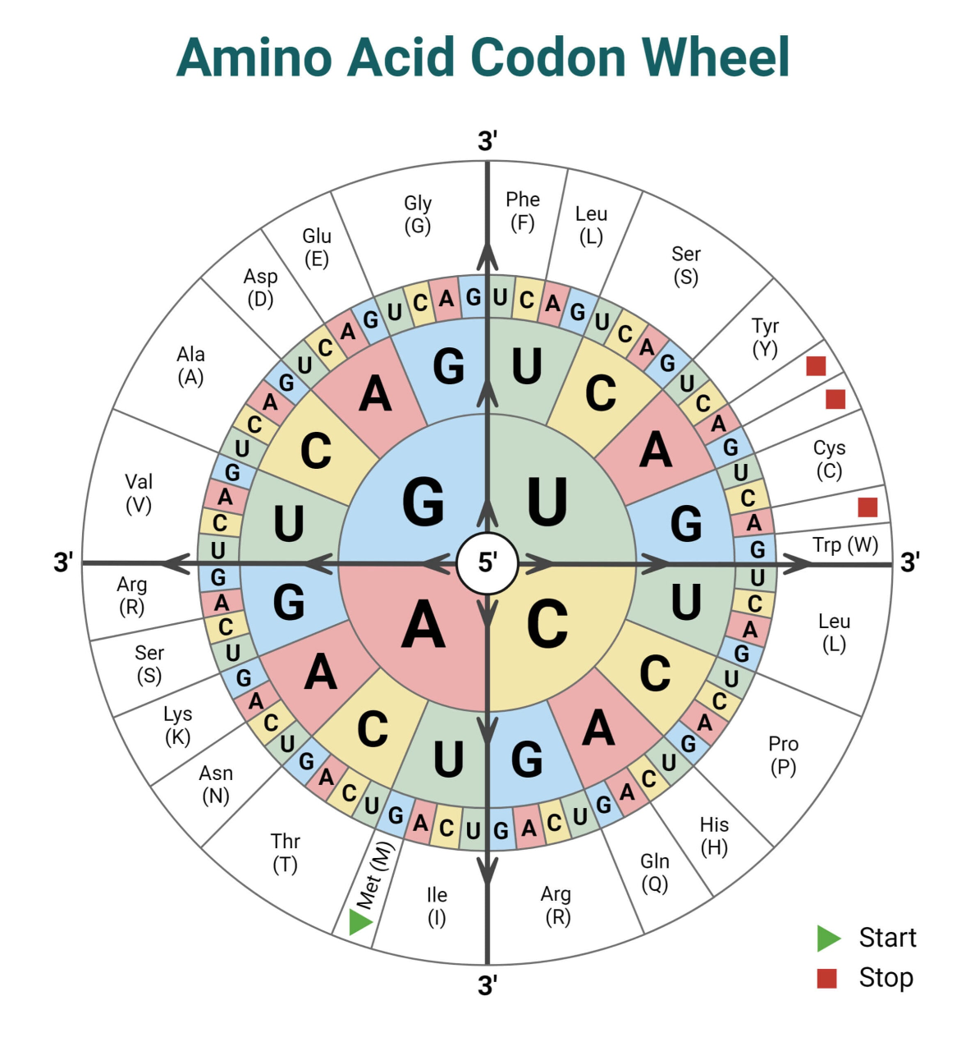
Lab Sheet: Back of Page
The 20 Amino Acids For each of the 20 amino acids:
-
Draw its chemical structure
-
Explain what it does for your body
-
List five plant foods that contain it Why plants only? Meat, eggs, and dairy contain all 20 amino acids, so they’d be the answer every time. Plants make you actually look. *Split the amino acids up evenly across your group. We will make copies so everyone has every amino acid.
-
Alanine
-
Arginine
-
Asparagine
-
Aspartic acid
-
Cysteine
-
Glutamic acid
-
Glutamine
-
Glycine
-
Histidine
-
Isoleucine
-
Leucine
-
Lysine
-
Methionine
-
Phenylalanine
-
Proline
-
Serine
-
Threonine
-
Tryptophan
-
Tyrosine
-
Valine
Your Message
As a group, write one message for future students. It will hang in this classroom for years, so make it count, and keep it school appropriate. Keep it short! How to build it
- Write your message in capital letters.
- Check for forbidden letters. B, J, O, U, X, and Z don’t exist in the genetic code. If your message has them, rewrite it.
- Translate each letter into an amino acid using the one-letter codes from your Codon Wheel.
- Find a codon for each amino acid on your codon wheel. Most have more than one, so pick any.
- Add the start and stop. Every word starts with AUG (methionine) and ends with a stop codon (UAA, UAG, or UGA). The stop codon also works as the space between words. When decoding, drop the M at the start of each word.
- Write out the full mRNA in groups of three.
- Write the DNA that made it. Under your mRNA, write the DNA template strand: A pairs with T, U pairs with A, G pairs with C.
- Test it. Trade your mRNA with another group. If they can’t decode it, find the mistake before anything gets strung.
- String it. One pony bead per base, with a clear bead between each codon: A = orange U = blue G = green C = silver Example: “TEACHERS NEED NAPS” mRNA: TEACHERS: AUG ACU GAA GCU UGU CAU GAA CGU UCU UAA NEED: AUG AAU GAA GAA GAU UAA NAPS: AUG AAU GCU CCU UCU UAA (Each word: start, letters, stop)